
How often do we talk about the need for creativity in the classroom? Time for students to pursue “passion projects”, to practice the 4 C’s, to prepare for their future world where they will have to be able to work together, problem solve and find solutions?
It’s a common theme these days, that most educators would agree is important. But much like the conversation around integrating technology in the classroom in meaningful ways, it’s often not given enough emphasis or time to actually happen. For that matter, how often are educators given time to be creative? With deadlines, paperwork, assessments, grades, intervention…. well the list goes on and on.
Of course there are pockets of creativity sprinkled everywhere. School maker spaces, teachers who are doing true project-based learning, classrooms where students are creating with devices rather than just consuming information. But how do we truly shift our thinking and create a climate where all kids get these kinds of opportunities? Where being creative and failing forward are celebrated rather than “fit in” somewhere in an already packed daily schedule?
I wish I could say I was smart enough that I had all the answers to these questions. While I am very excited about a new project we are working on in my district to bring these experiences to elementary kids, I know it’s just a drop in the bucket. (More on that project coming soon!) But this week, I have been reminded once again, why we need to be more diligent than ever in changing the education experience for our kids.
As an educator who has spent almost half of my career working with middle and high school students, I have seen the impact of education on their willingness to be creative as they get older. Quite simply, far too many students are disengaged and bored with high school, and even the smartest kids most often just want to know what they need to do to get the A. And as a mother of a 16 year old and 12 year old, I have witnessed the frustrations with school as well.
But this week, we had a reprieve. Snow days offered random, unscheduled time to pursue interests. My 16 year old received a 3-D printer for Christmas (after begging for two years!) Up until this week, he has entertained himself with printing projects that others have created. He’s done some troubleshooting with the printer setup and the occasional misprint, but nothing major. But this week when I took a vacation day and stayed home with the kids, I encouraged him to venture out a bit and recreate a hand-made project he had worked on last year in engineering class – a cube puzzle. Fast forward about 12 hours, and he designed and printed five pieces that fit together into a perfect cube puzzle. 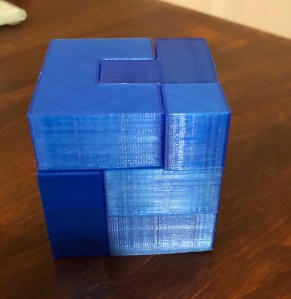
To say that he was proud of his finished product, would be an understatement. Taking his own design and turning it into digital files that he was then able to print was very rewarding. While there are likely lots of cube puzzles and files floating around out there, this one is his own one-of-a-kind creation. The ownership and success of the project was his alone. That is powerful. But he didn’t stop there.
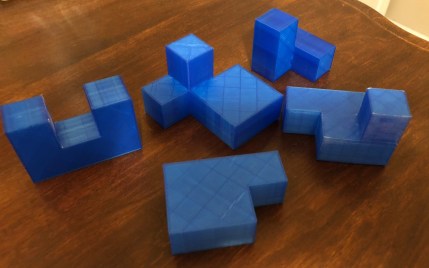
With just a little prodding, he decided to upload his project files to Thingiverse (which is apparently THE place to find 3-D files to print.) It may not seem like a big deal, but putting yourself out there for anyone to see your work and creativity can be a bit scary. Of course our always connected kids thrive (sometimes too much) on the feedback of others. As he proudly showed me his project, he was thrilled to see the number of views rise and that he even had several downloads of his project. (You can check out his project here and download the files to print your own cube!)
So what’s the point of this long story, besides a mom bragging on her kid? Well, I hope it is a reminder for you as it was for me, that we have to keep pushing for our kids to have these kinds of experiences. Many students won’t have an opportunity at home on a snow day to try their hand at something creative, because they simply won’t have access to the tools and resources they need. And of course it’s not all about making, but rather about providing time, opportunity and encouragement for students to think on their own and try something new. These are the tools that every kid will need to be successful.
So I’m curious…how are you helping build a culture of creativity in your schools? Please share your ideas and we can all shift together.
 shiftedlife.com